-
 +86 13616113658
-
 [email protected]
 English
 Español
 русский
 عربى
عربى
Single Glass Cleanroom Windows: Specs, Seals & Selection Guide
Content
- 1 The Direct Answer: Defining Functional Requirements
- 2 Structural Composition and Critical Material Science
- 3 Flush-Glazing and Air-Tight Sealing Mechanics
- 4 Fire-Rating Integration and Safety Code Compliance
- 5 Installation Variables: The Perimeter Silicone Joint
- 6 Optical Properties and Lighting Harmonization
- 7 Comparative Analysis: Single Pane vs. Dual Pane Systems
- 8 Validation Protocol for Installed Integrity
- 9 Custom Integration for Transfer Hatches
The Direct Answer: Defining Functional Requirements
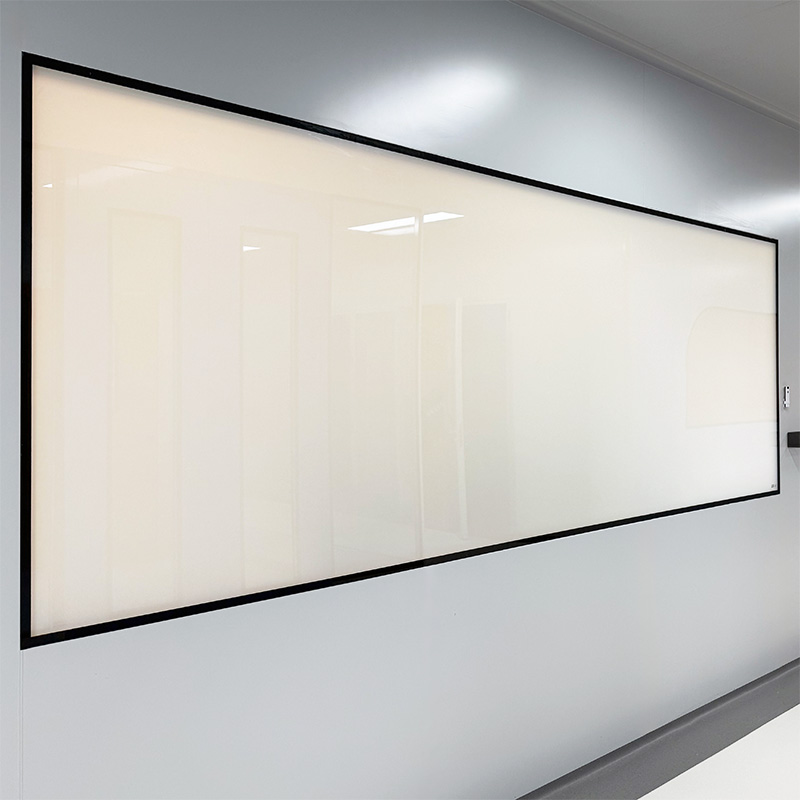
Selecting a single glass cleanroom window requires prioritizing air-tight sealing integrity and flush-mounted design above aesthetic concerns. A properly specified unit functions as a passive barrier that eliminates microbial breeding grounds while maintaining the precise pressure differential required for ISO 5 through ISO 8 environments. The primary objective is to achieve a completely flush surface on the clean side, preventing particle accumulation at the junction between the glass and the frame, which directly impacts viable and non-viable particulate counts during certification.
Structural Composition and Critical Material Science
The performance of a view panel relies on the chemical compatibility between the glazing substrate and the surrounding wall system. While the glass body offers optical clarity, the frame material dictates long-term durability against aggressive cleaning protocols.
Glass Substrate Selection
Standard tempered safety glass provides sufficient strength for most pass-through applications, typically resisting impact up to 10,000 psi. In environments utilizing vaporized hydrogen peroxide (VHP) biodecontamination, the glass must remain inert. Borosilicate options, though less common due to cost, offer superior resistance to thermal shock if the differential between the cleanroom and the adjacent gray space exceeds standard operating ranges.
Frame Material Compatibility
Stainless steel 304 or 316L frames are the standard for pharmaceutical manufacturing because they do not off-gas volatile organic compounds (VOCs) when exposed to strong oxidizing agents. Powder-coated aluminum presents a cost-effective alternative for electronics assembly, but specifiers must verify the coating undergoes a 10,000-volt DC holiday test to confirm the absence of pinholes that could expose the raw aluminum substrate to corrosive outgassing.
Flush-Glazing and Air-Tight Sealing Mechanics
The distinction between a standard architectural window and a cleanroom-rated unit lies almost entirely in the glazing bead profile. A flush-glazed design ensures the glass pane sits perfectly level with the inner frame lip, eliminating horizontal ledges where gravity forces particulate to settle. The secondary sealing mechanism typically involves a continuous co-extruded gasket made of medical-grade silicone or Ethylene Propylene Diene Monomer (EPDM).
Regarding pressure resistance, a 1/4-inch thick monolithic pane spanning 2 square feet can adequately resist a typical room pressure of 0.05 inches water column without deflection-induced seal failure. However, specifiers must be cautious of "pumping" effects during door operation. A momentary pressure spike can stress the perimeter bead. We recommend specifying a gasket compression set value of less than 15% after 70 hours at 212 degrees Fahrenheit to ensure decades of elastic recovery.
Fire-Rating Integration and Safety Code Compliance
In facilities where the wall assembly requires a specific fire-resistance rating, the window unit must mirror that integrity without warping the frame. Single panes rarely offer insulated protection against thermal transfer, but they can be fabricated with fire-rated ceramic glass capable of withstanding temperatures exceeding 1,600 degrees Fahrenheit for 45 to 60 minutes. The critical failure point is rarely the glass itself but the intumescent strip hidden within the frame. Upon heat exposure, this strip must expand rapidly to fill the void between the glass edge and the frame, preventing smoke migration through the wall opening. Ensure the manufacturer provides a UL-listed assembly number that covers the specific glass, frame, and glazing tape combination, rather than generic component listings.
Installation Variables: The Perimeter Silicone Joint
The theoretical performance of a factory-sealed unit becomes irrelevant if the rough opening installation is porous. The interface between the window frame and the cleanroom wall panel requires methodical filling. A neutrally-curing, low-VOC silicone must bridge the frame to the wall, creating a crevice-free radius cove.
Data from cleanroom smoke studies reveals that a 3/8-inch concave bead applied with a profiling tool reduces micro-turbulence at the wall junction significantly better than a standard tooled straight joint. Installers must also back-fill the space behind the frame flanges with low-pressure expanding foam that resists microbial growth. This prevents the cavity from acting as a return-air plenum bypass.
Optical Properties and Lighting Harmonization
Visible light transmittance dictates operator safety and color-accurate inspection capability. Low-iron single glass removes the greenish tint found in standard soda-lime float glass, pushing transmittance above 91%. This is critical in inspection suites where color rendering index (CRI) values of light sources must not be distorted by the glazing medium.
Anti-Reflective Coatings
In control rooms with high ambient luminance, single glass windows benefit from anti-reflective coatings applied via magnetron sputtering. These coatings reduce visible light reflection from 8% to below 1%, effectively eliminating the mirror effect that disorients technicians monitoring sensitive fermentation processes. Unlike laminated multi-layer solutions, these coatings are etched directly into the substrate, allowing the surface to withstand repeated wiping with 70% isopropyl alcohol without delamination.
Comparative Analysis: Single Pane vs. Dual Pane Systems
The choice between a single glass sheet and a dual-pane insulated unit hinges on condensation risk and contamination control priorities. While dual panes offer thermal breaks, they introduce interstitial spaces that are impossible to sterilize. The table below outlines the key performance differentiators for isolated barrier systems.
| Performance Criteria | Single Glass Standard | Double Pane Insulated (IGU) |
|---|---|---|
| Cleanability (Clean Side) | Single flush surface; zero recesses | Potentially multiple offsets; sealant cavity |
| Condensation Resistance | Moderate (depends on room dew point) | High (thermal break prevents surface dew) |
| Internal Contamination Risk | None (monolithic structure) | Risk of seal failure and internal fogging |
| Weight per Square Foot | Lower (approx. 3.0 lbs) | Higher (approx. 5.5 lbs dual assembly) |
Validation Protocol for Installed Integrity
Post-installation validation transfers the burden of proof from the specifier to the construction reality. A single glass window installation should be subjected to a multi-point scanning protocol. Using a calibrated photometer with a 0.1 micron sensitivity, technicians should challenge the interior seal perimeter while generating a dense aerosol of polydisperse particles on the interstitial side. A successful reading remains indistinguishable from zero-count background levels.
Furthermore, an airflow visualization near the window surface should demonstrate smooth, uninterrupted laminar sweep. A tell-tale indicator of a failed installation is the "curtain effect," where air cascading across the glass rolls backward at the gasket interface, trapping particles in a recirculation zone. The window must effectively vanish within the laminar field to support recovery rates required for critical zones.
Custom Integration for Transfer Hatches
Single glass configurations are frequently integrated into pass-through chambers that bridge two non-classified spaces to a sterile core. In this scenario, the glass must withstand a bidirectional mechanical load. The window acts as a safety barrier allowing visual confirmation that a transfer door on the opposite side is closed before the interlocking mechanism disengages. The critical specification here is not just surface flatness, but frameless edge polishing. A polished edge with a minimum 1-millimeter chamfer prevents the formation of micro-cracks during thermal sterilization cycles in ofen-type pass-throughs, ensuring the glass does not fail from dielectric stress caused by embedded heating elements.
Previous Post
Pharmaceutical Cleanroom HPL Purification Doors: Material, Standards & Selection
Next Post
High Speed Roll Up Doors: Performance & Selection Guide

Jiangyin Yatai Purification Equipment Technology Co., Ltd. is a modern and specialized manufacturer of clean doors and windows. Cleanroom Project Factory, offer Custom Clean Doors and Windows.
QUICK LINKS
PRODUCTS
GET IN TOUCHs
-
 +86 13616113658
-
 +86(0)510-86661588 / 86668687
-
 [email protected]
-
 +86(0)510-86661588
-
 No.2, Huagang West Road, Shizhuang, Jiangyin, Jiangsu province
© Jiangyin Yatai Purification Equipment Technology Co., Ltd.
All Rights Reserved.
 Cleanroom Door Manufacturers