-
 +86 13616113658
-
 [email protected]
 English
 Español
 русский
 عربى
عربى
Arc Cleanroom Window: Types, Design Requirements & Applications
Content
What Is an Arc Cleanroom Window?
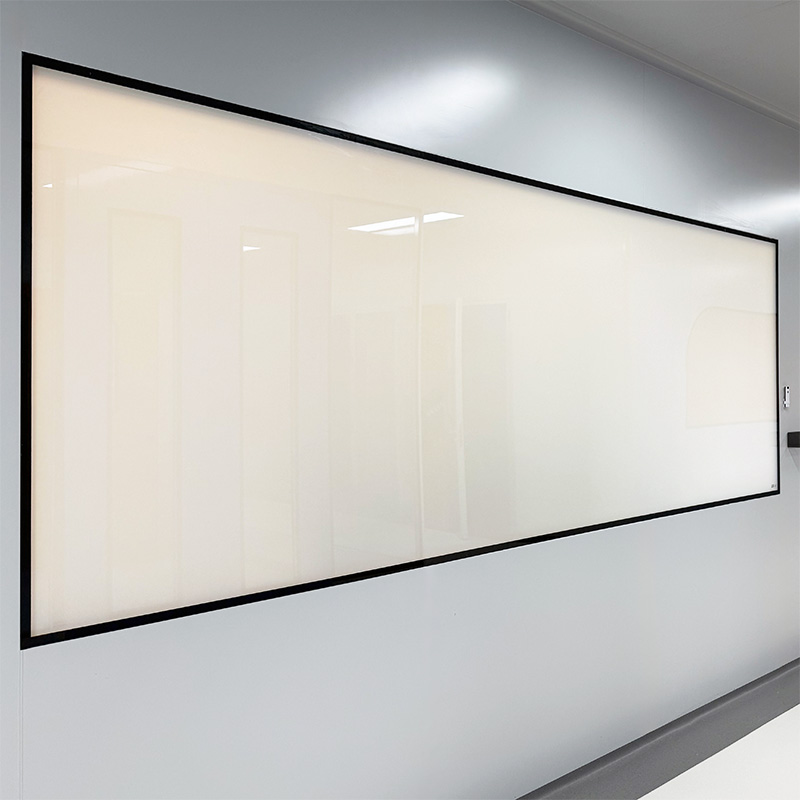
An arc cleanroom window — also called a curved or radius cleanroom window — is a specially fabricated glazing unit designed with a curved profile to fit arched wall openings, curved corridor walls, or rounded observation bays within controlled environments. Unlike standard flat panel windows, arc cleanroom windows maintain the same rigorous contamination-control performance as their flat counterparts: flush interior surfaces, hermetically sealed frames, and particle-resistant construction that meet ISO 14644 cleanroom classification requirements.
These windows are commonly specified in pharmaceutical manufacturing suites, semiconductor fabrication facilities, biotechnology labs, aerospace assembly cleanrooms, and hospital operating theaters where curved architecture improves airflow dynamics or meets specific spatial design requirements.
Key Design and Performance Requirements
Selecting the right arc cleanroom window requires balancing structural integrity, contamination control, and optical clarity. The following performance criteria are standard across most regulated industries:
- Flush interior face: The window must sit flush with the interior wall surface to eliminate ledges, crevices, or horizontal surfaces where particulates can accumulate.
- Sealed, non-outgassing frame: Aluminum or stainless steel frames with silicone or EPDM gaskets prevent vapor transmission and withstand repeated cleaning with IPA, hydrogen peroxide vapor (HPV), or other aggressive disinfectants.
- Laminated or tempered glazing: Double-glazed units with tempered or laminated inner and outer lites provide impact resistance and thermal insulation. For ISO Class 5 and above environments, units with U-values below 1.8 W/m²K are preferred to minimize condensation risks.
- Continuous radius consistency: The curved profile must be geometrically consistent along its entire arc to ensure airtight contact with the surrounding wall panel system and prevent air infiltration.
- Electrostatic dissipative (ESD) coatings: In semiconductor or microelectronics cleanrooms, ESD-treated glass prevents static buildup that could attract sub-micron particles or damage sensitive components.
Arc Cleanroom Window vs. Flat Cleanroom Window: A Comparison
Facility managers often evaluate whether the added complexity of arc windows justifies their cost premium over standard flat units. The table below outlines the key differences:
| Feature | Arc Cleanroom Window | Flat Cleanroom Window |
|---|---|---|
| Wall compatibility | Curved / radius walls | Straight walls only |
| Lead time | 4–10 weeks (custom fabrication) | 2–4 weeks (standard sizes available) |
| Airflow benefit | Supports laminar flow in curved corridors | Optimized for standard rectangular layouts |
| Cost | Higher (custom bending, tooling) | Lower (standard production) |
| ISO classification support | ISO Class 3–8 | ISO Class 3–8 |
Fabrication Methods and Materials
Arc cleanroom windows are produced through one of two primary fabrication approaches:
Cold-Bent Glass
In cold-bending, flat tempered or laminated glass is mechanically curved at ambient temperature and held in shape by the frame. This method is cost-effective for large-radius arcs (typically above 3,000 mm radius) and produces minimal optical distortion when executed correctly. However, residual stress in the glass must be carefully managed to avoid long-term delamination or cracking.
Hot-Bent (Slumped) Glass
Hot-bending involves heating glass to approximately 600–650 °C and allowing it to conform to a mold. This produces a permanent, stress-free curve suitable for tighter radii and more complex geometries. Hot-bent units offer superior optical clarity and long-term dimensional stability, making them the preferred choice for critical observation windows in pharmaceutical or semiconductor environments.
Frame materials are typically 6063-T5 or 6061-T6 aluminum alloy with anodized or powder-coated finishes, or 316L stainless steel for applications involving aggressive chemical wipe-down protocols. Both materials are compatible with cleanroom wall panel systems from major suppliers including Kingspan, Asahi Kasei, and USG Boral.
Installation Considerations for Arc Cleanroom Windows
Proper installation is as critical as the window specification itself. Poor installation can compromise the cleanroom envelope and invalidate ISO classification. Key installation steps include:
- Precise radius matching: The window's arc radius must be fabricated to match the as-built wall radius within ±2 mm tolerance. On-site measurement after wall panel installation — not off shop drawings — is strongly recommended.
- Continuous perimeter sealing: A continuous bead of cleanroom-grade silicone sealant (low-VOC, fungicide-free) must be applied at the frame-to-wall interface on the interior face. No gaps or bridging.
- Pressure equalization: Double-glazed arc units require desiccant spacer bars filled to capacity to prevent moisture ingress in the cavity, which is more susceptible to failure in curved units due to variable edge stress.
- Post-installation leak testing: Smoke pencil or tracer gas tests should verify that the installed window does not disrupt the cleanroom's pressurization cascade before the suite is certified.
Applications Driving Demand for Arc Cleanroom Windows
The growing adoption of curved architectural elements in modern cleanroom design — driven by both functional and ergonomic considerations — has expanded the market for arc cleanroom windows significantly over the past decade. Primary application sectors include:
- Pharmaceutical and biopharmaceutical manufacturing: GMP-compliant suites for aseptic fill-finish, cell therapy, and mRNA production increasingly feature rounded internal corridors to eliminate dead zones in unidirectional airflow systems.
- Semiconductor fabs: Lithography bays with curved observation galleries allow process engineers to monitor equipment without entering the ISO Class 5 core zone.
- Hospital operating theaters: Curved scrub-sink alcoves and observation windows between OR suites and galleries use arc windows to maintain infection-control barriers while allowing surgical team supervision.
- Aerospace component assembly: Satellite and optical instrument cleanrooms use curved transition zones between cleanliness classes, requiring windows that conform to the wall geometry while maintaining differential pressure integrity.
As cleanroom design continues to evolve toward more flexible, people-centric layouts, arc cleanroom windows will remain a critical specification item for architects and facility engineers seeking to reconcile architectural ambition with contamination-control performance.
Previous Post
Airtight Cleanroom Doors: Sealing Tech for Efficiency
Next Post
Cleanroom Fire Doors: Standards, Features & Selection Guide

Jiangyin Yatai Purification Equipment Technology Co., Ltd. is a modern and specialized manufacturer of clean doors and windows. Cleanroom Project Factory, offer Custom Clean Doors and Windows.
QUICK LINKS
PRODUCTS
GET IN TOUCHs
-
 +86 13616113658
-
 +86(0)510-86661588 / 86668687
-
 [email protected]
-
 +86(0)510-86661588
-
 No.2, Huagang West Road, Shizhuang, Jiangyin, Jiangsu province
© Jiangyin Yatai Purification Equipment Technology Co., Ltd.
All Rights Reserved.
 Cleanroom Door Manufacturers