-
 +86 13616113658
-
 [email protected]
 English
 Español
 русский
 عربى
عربى
Cleanroom Fire Doors: Standards, Features & Selection Guide
Content
- 1 What Makes a Fire Door Suitable for a Cleanroom
- 2 Key Performance Standards and Certifications
- 3 Materials, Construction, and Surface Specification
- 4 Sealing Systems and Pressure Differential Control
- 5 Hardware, Automation, and Access Control Integration
- 6 How to Select the Right Cleanroom Fire Door for Your Project
What Makes a Fire Door Suitable for a Cleanroom
A standard fire door is engineered to resist the spread of flame and smoke. A cleanroom fire door must do all of that — and simultaneously maintain the environmental integrity of a controlled space. These two demands create a product category with precise, overlapping requirements that ordinary fire doors cannot meet.
In a cleanroom, the door must not introduce particles, outgas volatile compounds, or disrupt air pressure differentials. At the same time, it must achieve a certified fire resistance rating — typically 30, 60, or 90 minutes depending on the facility's fire compartmentation strategy. This combination distinguishes cleanroom fire doors from both standard fire doors and conventional cleanroom doors.
Facilities that require this product include pharmaceutical manufacturing plants, semiconductor fabs, hospital operating theatres, biotech laboratories, and ISO-classified food processing environments. In each setting, a fire event that destroys both life safety and contamination control simultaneously represents a dual catastrophe — which is precisely why the door specification matters.
Key Performance Standards and Certifications
Cleanroom fire doors are subject to a layered certification framework. The fire resistance component is tested against regional standards such as EN 13501-2 in Europe, NFPA 80 in the United States, and BS 476 in the UK. These standards evaluate integrity (resistance to flames and hot gases) and insulation (resistance to heat transfer through the door leaf).
Cleanroom performance is governed by ISO 14644-1, which classifies environments from ISO Class 1 (the most stringent) to ISO Class 9. Doors used in ISO Class 5 and above environments face the most demanding cleanliness requirements, including limits on particle generation from the door's surface, seals, and hardware.
Additional certifications that may apply include:
- GMP compliance — required for pharmaceutical and medical device facilities regulated under EU GMP Annex 1 or FDA 21 CFR Part 211
- CE marking — mandatory for fire doors sold within the European Economic Area
- EI or EW classification — denotes whether the door provides both integrity and insulation (EI) or integrity only with limited radiation control (EW)
- Smoke control ratings (Sa or S200) — relevant where smoke containment is part of the fire strategy
Procurement teams should request full third-party test evidence rather than relying solely on manufacturer declarations. The test report should match the exact door configuration — leaf dimensions, glazing area, ironmongery, and frame type — as installed on-site.
Materials, Construction, and Surface Specification
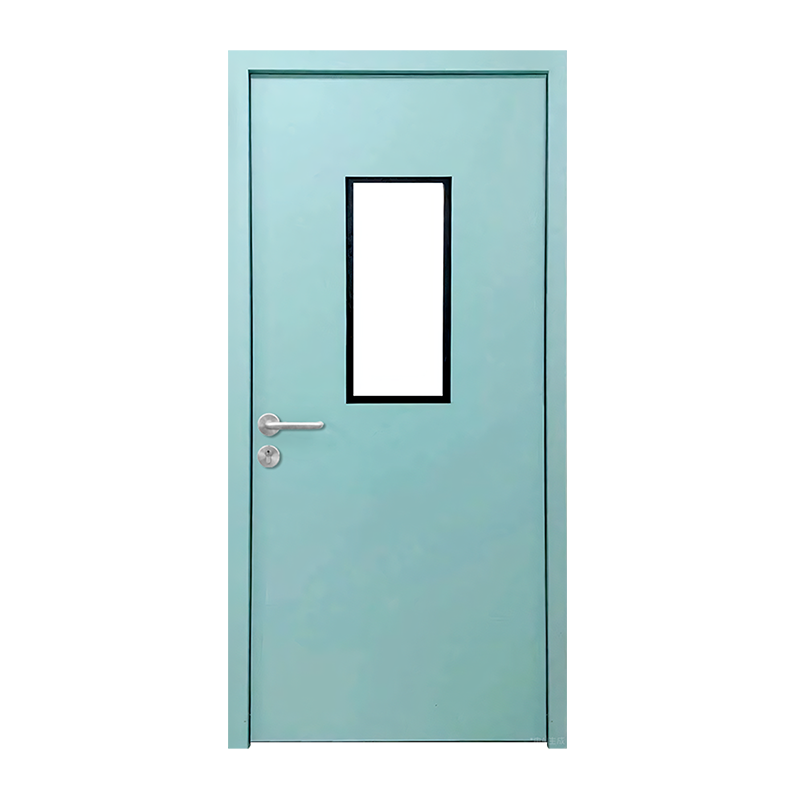
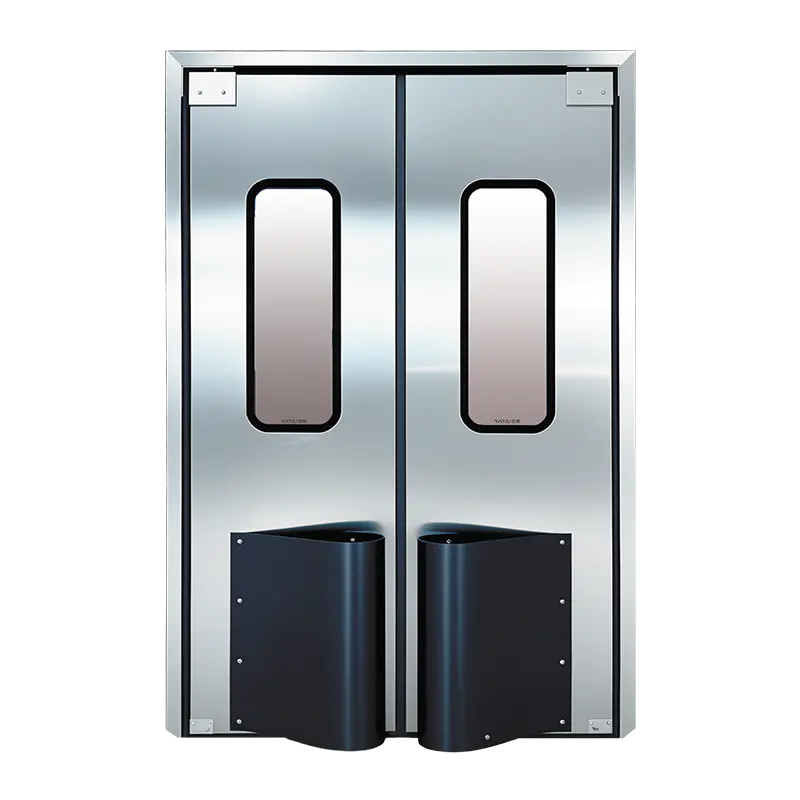
The structural core of a cleanroom fire door is typically composed of a fire-rated mineral board or honeycomb steel infill encased within a steel or stainless steel skin. Stainless steel (commonly Grade 304 or 316) is the preferred facing material in pharmaceutical and food environments because of its corrosion resistance, wipedown durability, and low particle shedding.
Flush panel construction is standard — any surface projection or recessed hardware is a contamination trap. All edges, joints, and corners are fully welded and ground smooth to eliminate crevices where microorganisms or particles could accumulate. Door frames are similarly designed with sloped sills or threshold seals rather than horizontal ledges.
| Surface Material | Typical Application | Key Advantage |
|---|---|---|
| Stainless Steel 304 | Pharma, food processing | Corrosion resistance, wipedown-ready |
| Stainless Steel 316 | Aggressive chemical environments | Higher chloride resistance |
| Powder-coated Steel | Electronics, general ISO 7–8 | Cost-effective, smooth surface |
| GRP (Glass Reinforced Plastic) | High-humidity cleanrooms | Lightweight, non-corroding |
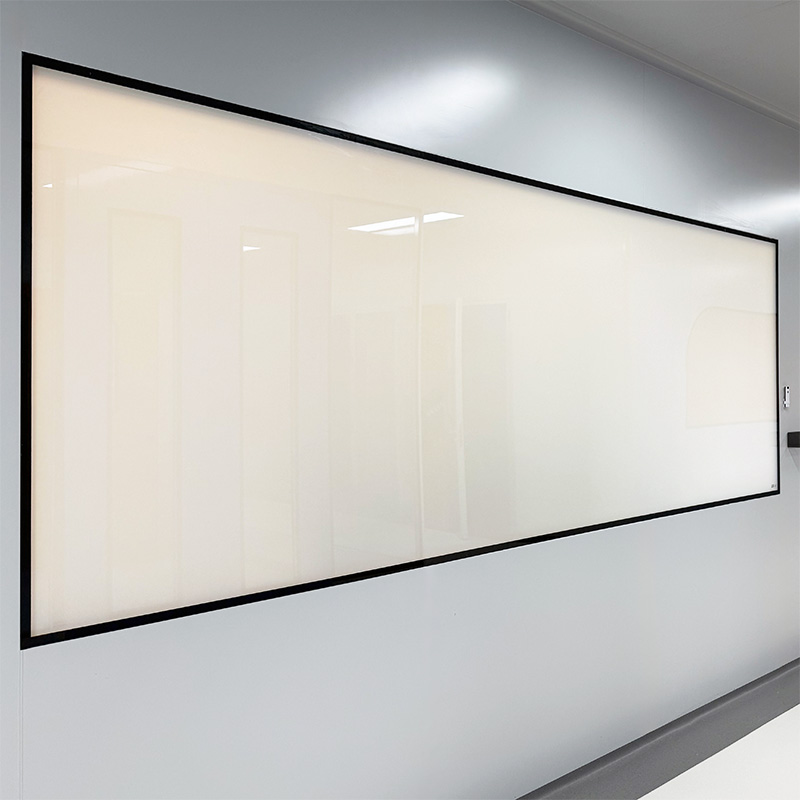
Glazing, when required for visibility or pass-through light, must use fire-rated glass achieving the same EI or EI2 classification as the door leaf. Wired glass is unsuitable for cleanrooms due to particle and corrosion risks; borosilicate or pyro-ceramic glazed units are the accepted alternatives.
Sealing Systems and Pressure Differential Control
The sealing system of a cleanroom fire door serves two simultaneous functions: it must expand and form a fire-tight barrier under heat, and it must provide an airtight perimeter seal under normal operating conditions to preserve the cleanroom's pressure differential.
Intumescent strips are embedded in the door rebate or the frame perimeter. When exposed to temperatures above approximately 200°C, the material expands to fill any gap between the door leaf and frame, blocking the passage of flames and hot gases. In everyday operation, these strips remain compressed and contribute to the air seal.
For cleanrooms operating at positive pressure (typical in pharmaceutical fill-finish or semiconductor areas), the door seal must reliably hold a pressure differential of 10–15 Pa or more without deflection or leakage. For negative-pressure environments (biosafety laboratories, containment zones), the design requirement reverses: the seal must prevent contaminated air from escaping under negative differential.
Automatic drop seals at the door base address the threshold challenge — a bottom seal that activates on door closure avoids the tripping hazard of a raised sill while maintaining both fire and air containment. These mechanisms must be specified with stainless steel housings and tested to confirm they do not impede fire door self-closing under load.
Hardware, Automation, and Access Control Integration
All hardware on a cleanroom fire door must be fire-rated to match the door's classification. This includes hinges, closers, panic hardware, and locking mechanisms. Hardware that is not included within the original fire test evidence invalidates the door's certification — a detail frequently overlooked during fit-out modifications.
Self-closing mechanisms are a mandatory fire door requirement. In high-traffic cleanroom environments, electromagnetic hold-open devices linked to the building fire alarm system are widely used. These allow doors to remain open during normal operations — reducing air turbulence from repeated manual opening — while releasing automatically on alarm activation.
Automation is increasingly specified for cleanroom fire doors in pharmaceutical environments where hands-free operation minimises contamination risk. Sliding, swing, or air-lock double-door configurations can all be motorised while retaining fire certification, provided the automation package has been included in the fire test or assessed by a competent fire engineer as an equivalent arrangement.
Access control integration — card readers, keypads, biometric readers — must be installed using recessed or flush-mounted housings to preserve the smooth door face. Cabling penetrations through the door leaf are not permissible; all wiring should route through the frame with fire-rated cable sleeves.
How to Select the Right Cleanroom Fire Door for Your Project
Selecting the correct door begins with defining four parameters: the required fire resistance rating, the cleanroom ISO classification, the pressure differential regime, and the traffic and operational pattern. These four inputs determine which material specification, seal design, hardware configuration, and automation level is appropriate.
A structured approach to specification should cover:
- Fire rating: Confirm the required compartmentation period with your fire engineer — FD30, FD60, FD90, or FD120.
- ISO class: Higher ISO classes (ISO 5 and above) demand lower particle generation surfaces and may require full stainless steel specification.
- Pressure control: Establish the operating differential and whether the cleanroom runs positive or negative pressure.
- Regulatory context: Pharmaceutical GMP, medical device MDR, semiconductor SEMI S2, or food safety BRC/SQF requirements each carry specific door surface and documentation obligations.
- Documentation package: Request full fire test evidence, CE declaration of performance, IQ/OQ protocols (for GMP facilities), and third-party inspection reports as standard deliverables.
Working with a manufacturer who can provide doors tested as a complete, certified assembly — leaf, frame, seals, glazing, and hardware — reduces the risk of specification gaps that only surface during building control inspection or regulatory audit. A correctly specified cleanroom fire door protects both people and process, making it one of the highest-consequence decisions in controlled environment design.
Previous Post
Arc Cleanroom Window: Types, Design Requirements & Applications
Next Post
How to Choose the Right Door for Your Cleanroom

Jiangyin Yatai Purification Equipment Technology Co., Ltd. is a modern and specialized manufacturer of clean doors and windows. Cleanroom Project Factory, offer Custom Clean Doors and Windows.
QUICK LINKS
PRODUCTS
GET IN TOUCHs
-
 +86 13616113658
-
 +86(0)510-86661588 / 86668687
-
 [email protected]
-
 +86(0)510-86661588
-
 No.2, Huagang West Road, Shizhuang, Jiangyin, Jiangsu province
© Jiangyin Yatai Purification Equipment Technology Co., Ltd.
All Rights Reserved.
 Cleanroom Door Manufacturers