-
 +86 13616113658
-
 [email protected]
 English
 Español
 русский
 عربى
عربى
Cleanroom Fire-Resistant Doors: Ratings, Materials & Selection Guide
Content
- 1 When Fire and Cleanliness Standards Collide
- 2 Fire Resistance Ratings Decoded: Class A, B, and C
- 3 What's Actually Inside: Construction That Delivers the Rating
- 4 Cleanroom-Specific Surface and Frame Requirements
- 5 Where These Doors Are Actually Deployed
- 6 Four Questions That Determine the Right Specification
- 7 The Certification Check You Cannot Skip
When Fire and Cleanliness Standards Collide
Pharmaceutical production lines, semiconductor fabs, and hospital operating theaters share one uncomfortable reality: they concentrate both high-value processes and significant fire risk in tightly controlled spaces. A standard fire door seals a compartment. A cleanroom fire-resistant door has to do that and maintain a particle-controlled, pressure-differential barrier — simultaneously. Getting the specification wrong on either dimension creates either a compliance gap or a safety gap. This guide cuts through the overlap so you can make an informed decision.
Fire Resistance Ratings Decoded: Class A, B, and C
The single most misunderstood aspect of fire door purchasing is the rating system. Resistance time is not interchangeable across standards — a "60-minute door" certified under GB 12955 (Chinese standard) and one certified under EN 13501-2 (European) are not equivalent products. Always confirm which standard the certification applies to before comparing quotes.
| Class | Fire Resistance Limit | Typical Application |
|---|---|---|
| Class A | 90 minutes | High-risk zones, escape routes, pharmaceutical fill-finish areas |
| Class B | 60 minutes | Internal zonal separation, electronics fabs, food processing |
| Class C | 36 minutes | Low-risk corridors, auxiliary cleanroom spaces |
A Class A door rated at 90 minutes is required wherever local fire codes mandate maximum containment — typically corridors adjacent to exit routes or zones handling flammable substances. For most internal partitions within a cleanroom, Class B at 60 minutes is the practical standard. Class C covers low-occupancy auxiliary spaces. Per NFPA 80 guidance on fire door ratings, the required protection level is determined by the fire resistance rating of the wall assembly the door is installed in — always specify wall and door in tandem.
What's Actually Inside: Construction That Delivers the Rating
Three components determine whether a cleanroom fire door achieves its rated time — and whether it survives cleanroom service life without degrading the seal.
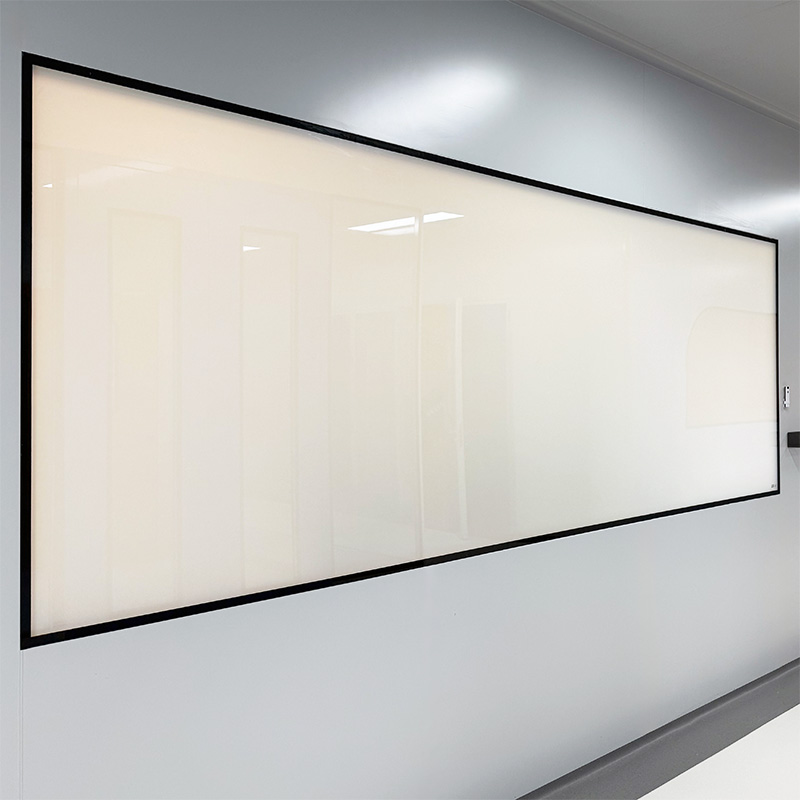
Crystal silicon fireproof glass. Standard wired glass disintegrates under thermal shock. Crystal silicon glass is a composite heat-insulating material that remains structurally stable throughout the rated exposure period. It blocks radiant heat transmission, which is critical in cleanrooms where personnel may be working near the door during an incident.
Fireproof expansion sealing strip. The gap between a door leaf and its frame is the primary smoke migration path. A conventional EPDM seal compresses and holds — but does not expand. The expansion strip used in certified cleanroom fire rated door assemblies carries an expansion coefficient of 20×: on contact with heat, it swells to fill the entire perimeter gap, forming a combined fire-and-smoke barrier within seconds of temperature rise.
High-temperature hardware. Standard stainless steel door hinges and closers begin to lose structural integrity above 600 °C. Certified cleanroom fire door hardware must have a melting temperature of not less than 950 °C — a figure that matters when a Class A door is expected to hold a compartment for 90 minutes in a fully developed fire.
Cleanroom-Specific Surface and Frame Requirements
Fire performance is half the specification. The other half is particle control. The two requirements pull in opposite directions — fire-rated frames traditionally use exposed mechanical joints; cleanroom requirements demand seamless, flush surfaces with no horizontal ledges.
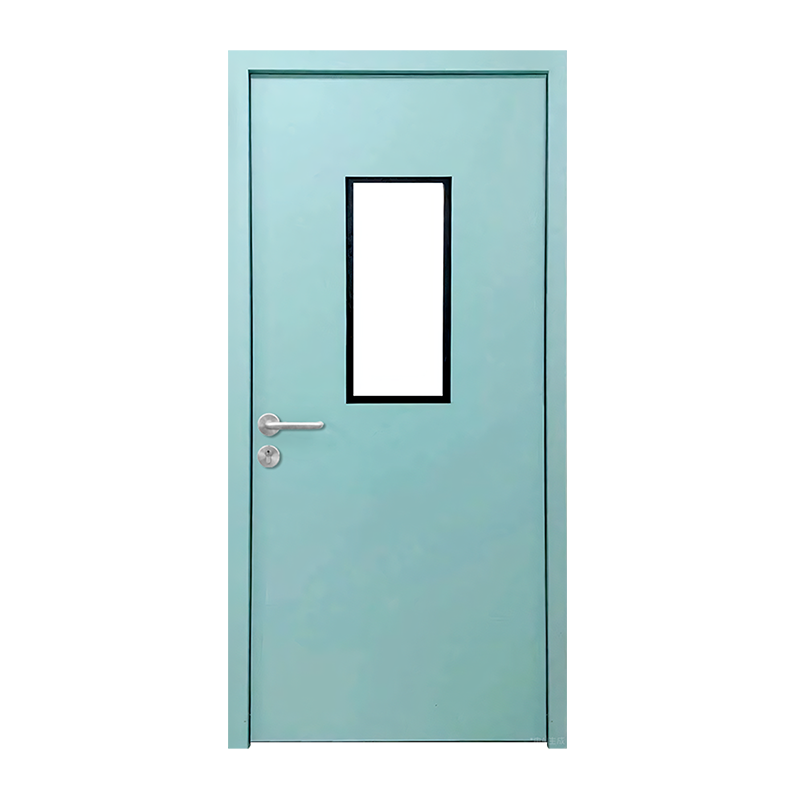
The resolution is in the manufacturing approach. Galvanized steel door panels and frames with powder-coated surfaces eliminate corrosion while providing a chemically resistant wipe-down surface. Critically, frames and panels must have no joints, no dead corners, and no exposed fasteners on the cleanroom-facing side — every crevice is a particle trap and a microbial breeding ground. Door frame configurations — flat frame, encircled frame, butt clamp, or paired clamping types — are selected based on wall construction (50–100 mm color steel plate, civil wall, or light steel keel), not aesthetic preference.
For facilities that also require emergency egress, pairing fire-rated swing doors with a compliant emergency exit door designed for controlled environments ensures the egress path maintains both fire containment and cleanroom integrity simultaneously.
Where These Doors Are Actually Deployed
Cleanroom fire doors are not a one-industry product. Pharmaceutical sterile fill-finish suites require Class A doors on every exit route per GMP guidelines. Semiconductor fabs use Class B internally to separate chemical storage from the fab floor. Hospital operating rooms and isolation wards need doors that pass both infection control and fire inspection — often the same inspection cycle. Food processing facilities handling flammable sanitizers or aerosols add fire resistance to their hygienic door specification as a process-safety measure, not just a building code requirement.
Four Questions That Determine the Right Specification
Before contacting a supplier, answer these four questions in writing. They define the entire specification:
- What fire resistance rating does the wall require? The door rating follows the wall. A 2-hour fire-rated wall requires a Class A door; a 1-hour wall permits Class B.
- What is the cleanroom ISO classification? ISO 5 and above require smoother surfaces and tighter frame tolerances than ISO 8 corridors.
- What is the pressure differential? Positive-pressure cleanrooms exert outward force on the door leaf continuously — frame-to-wall anchoring and hinge specification must account for this load in addition to fire performance.
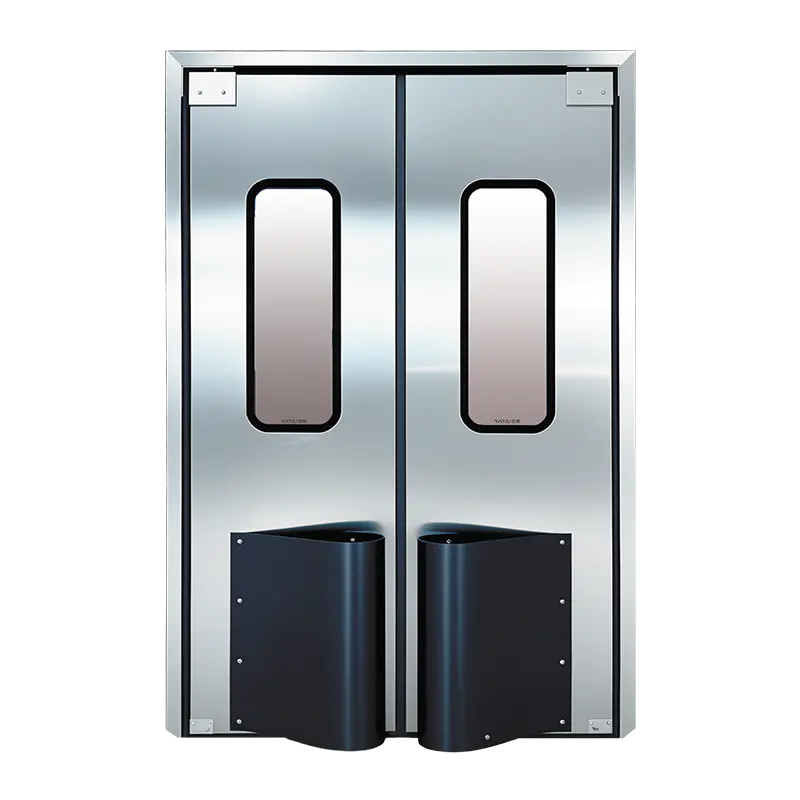
- Single, double, or unequal double-leaf? Large equipment access requires double-leaf or unequal-leaf configurations that still achieve the rated fire resistance across the full opening width — this requires testing of the full assembly, not just the leaf.
Reviewing the complete range of cleanroom door types and configurations alongside fire-rated options helps clarify which zones need fire resistance and which need other performance characteristics — airtightness, radiation shielding, or high-speed cycling.
The Certification Check You Cannot Skip
Every fire door sold into a regulated facility should carry a third-party inspection report specific to its class — Grade A and Grade B inspection reports are separate documents, not a single certificate covering all ratings. Ask for the test report number, the testing laboratory, and the date of certification. Hardware melting-point data should be a separate datasheet. A supplier unable to produce these documents within 48 hours is a supplier whose certification trail does not exist.
Specifying the right cleanroom fire-resistant door is a one-time decision that protects your facility for the life of the installation. The cost difference between a correct and incorrect specification is negligible compared to the cost of a failed fire inspection — or worse, a fire event in a facility that assumed the door would hold.
Previous Post
Airtight Automatic Sliding Doors: Specs, Standards & Selection Guide
Next Post
Single Glass Cleanroom Windows: Key Specs, Frame Types & Selection Tips

Jiangyin Yatai Purification Equipment Technology Co., Ltd. is a modern and specialized manufacturer of clean doors and windows. Cleanroom Project Factory, offer Custom Clean Doors and Windows.
QUICK LINKS
PRODUCTS
GET IN TOUCHs
-
 +86 13616113658
-
 +86(0)510-86661588 / 86668687
-
 [email protected]
-
 +86(0)510-86661588
-
 No.2, Huagang West Road, Shizhuang, Jiangyin, Jiangsu province
© Jiangyin Yatai Purification Equipment Technology Co., Ltd.
All Rights Reserved.
 Cleanroom Door Manufacturers