-
 +86 13616113658
-
 [email protected]
 English
 Español
 русский
 عربى
عربى
Home / Media / Industry News / Pharmaceutical Cleanroom HPL Purification Doors: Material, Standards & Selection
Pharmaceutical Cleanroom HPL Purification Doors: Material, Standards & Selection
Content
- 1 Why the Door Material Defines Your Cleanroom's Contamination Risk
- 2 What Makes HPL the Right Surface for Pharmaceutical Environments
- 3 The Aluminum Alloy Frame: Structural Integrity and Airtight Sealing
- 4 How HPL Doors Support ISO 14644 and GMP Compliance
- 5 Selecting the Right Purification Door for Your Facility
- 6 Installation and Maintenance Considerations
Why the Door Material Defines Your Cleanroom's Contamination Risk
Pharmaceutical cleanrooms operate under ISO 14644 and cGMP regulations that leave no room for shortcuts — and the door is the single most frequently disturbed barrier in the entire enclosure. Every swing transfers air, particles, and potential contaminants between zones. Choosing the wrong door material doesn't just create a maintenance headache; it can trigger a batch rejection or a regulatory finding.
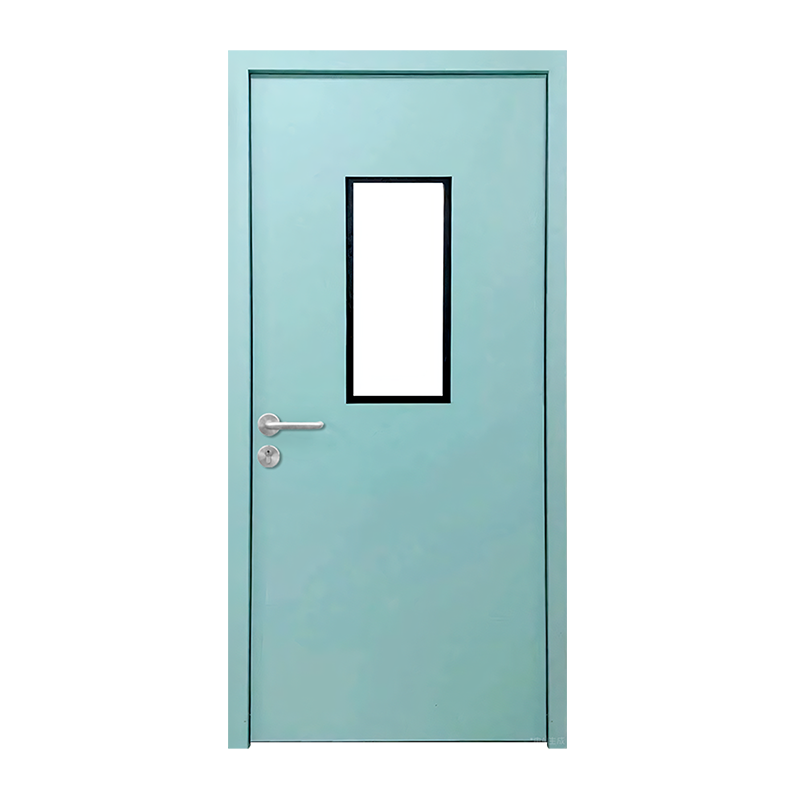
High Pressure Laminate (HPL) purification doors have become the dominant choice across pharmaceutical production floors precisely because the material addresses every major compliance pressure point at once.
What Makes HPL the Right Surface for Pharmaceutical Environments
HPL is a composite panel produced by bonding multiple resin-impregnated kraft paper layers under high heat and pressure, then finishing with a decorative melamine surface. The result is a non-porous, seamless face that particle-generating materials like wood simply cannot match. GMP regulations explicitly prohibit wood in cleanroom construction because its fibrous, porous structure harbors microbial growth — a risk HPL eliminates entirely.
From a performance standpoint, HPL panels used in cleanroom doors typically deliver:
- Impact and scratch resistance that survives trolley and cart traffic without delaminating
- Chemical resistance to common pharmaceutical disinfectants including isopropyl alcohol, hydrogen peroxide, and quaternary ammonium compounds
- A non-fading surface that maintains its appearance through repeated wipe-down cycles
- Class B fire resistance rating — meeting standard fire safety thresholds required in production facilities
The door panel can be configured with 3 mm or 4 mm HPL sheet depending on the mechanical load expected, with core infill options including paper honeycomb, aluminum honeycomb, rock wool, or PU foam selected based on thermal and acoustic requirements.
The Aluminum Alloy Frame: Structural Integrity and Airtight Sealing
The frame carries as much functional weight as the panel itself. Aluminum alloy frames paired with HPL panels deliver the combination the pharmaceutical industry needs: corrosion resistance, dimensional stability, and — critically — a platform for double-seal gasket systems.
A double-seal design on the door perimeter ensures that pressure differentials between cleanroom zones are maintained even under frequent opening cycles. GMP and ISO 14644 both require that pressure differentials of 5–15 Pa be sustained between adjacent cleanroom grades. A poorly sealed door frame is one of the most common sources of pressure cascade failure.
The aluminum alloy HPL cleanroom door range features encircled frame and flat frame configurations — the choice between them typically depends on wall panel thickness and the installation method preferred by the facility's construction team. Both configurations support the automatic drop-down bottom seal that closes the threshold gap the moment the door reaches the closed position, preventing underfloor air bypass.
How HPL Doors Support ISO 14644 and GMP Compliance
ISO 14644-1 classifies cleanrooms by airborne particle concentration. Pharmaceutical aseptic filling areas typically require ISO Class 5 (equivalent to EU GMP Grade A), where the allowable particle count is capped at 3,520 particles of 0.5 µm or larger per cubic meter. Maintaining that figure requires more than air handling — every penetration in the envelope, including doors, must be engineered to prevent ingress.
HPL purification doors contribute to ISO compliance in three direct ways:
- Non-particle-shedding surface: Unlike painted steel that chips or powder-coated panels that scratch through to bare metal, HPL maintains a sealed face that does not generate particles from surface degradation.
- Easy decontamination: EU GMP Annex 1's Contamination Control Strategy (CCS) requirements, updated in 2022, demand surfaces that can be reliably decontaminated. HPL's smooth, non-porous face allows validated wipe-down procedures to achieve consistent bioburden reduction.
- Pressure zone integrity: The double-seal aluminum frame system maintains the differential pressure cascade required between Grade A/B and Grade C/D areas.
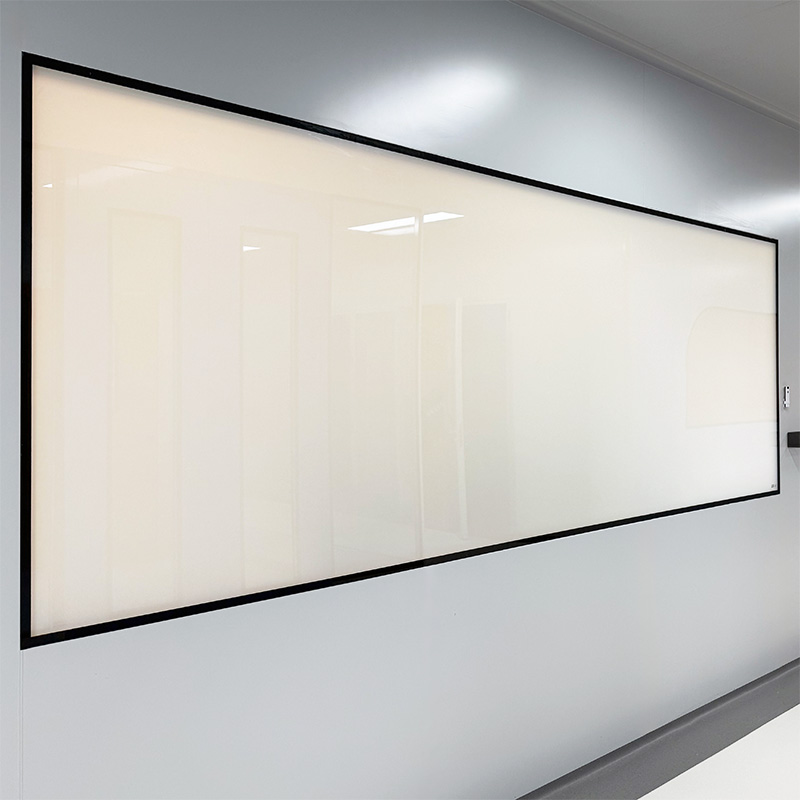
Facilities also benefit from the door's compatibility with interlock systems, door closers, and vision panels — all of which can be integrated without compromising the seal or the structural rating.
Selecting the Right Purification Door for Your Facility
Not every pharmaceutical zone carries the same risk profile, and door specification should reflect that. Here is a practical selection framework:
| Zone / ISO Class | Recommended Door Type | Key Feature Priority |
|---|---|---|
| ISO Class 5–6 (Grade A/B) | HPL with aluminum frame + auto drop-seal | Double sealing, interlock-ready, smooth decontaminable surface |
| ISO Class 7 (Grade C) | HPL or color steel with aluminum frame | Chemical resistance, airtight frame, vision panel |
| ISO Class 8 (Grade D) | Steel or aluminum alloy frame steel door | Durability, easy cleaning, cost efficiency |
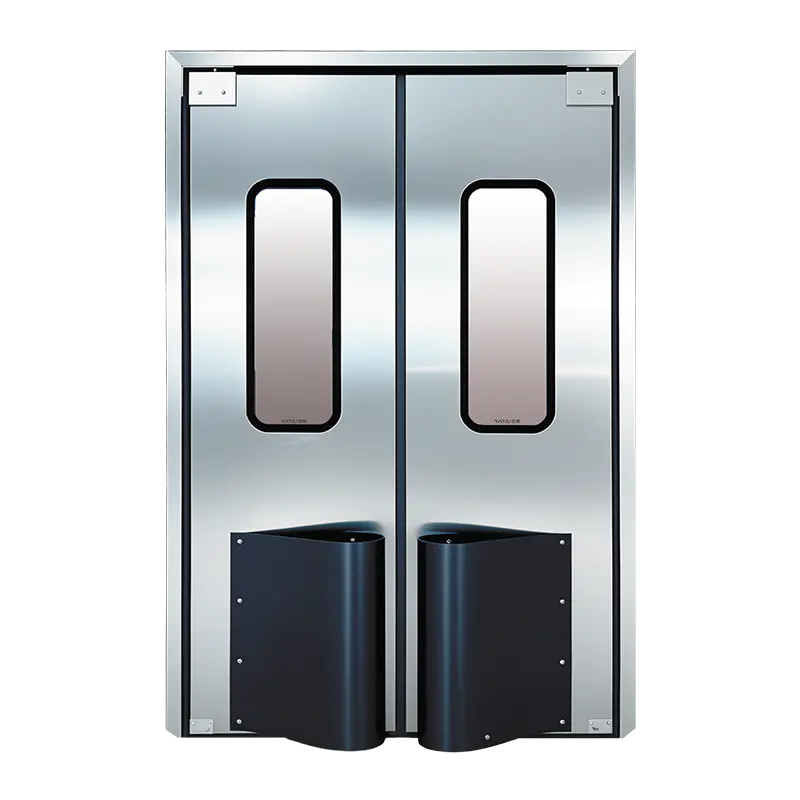
| High-traffic corridors | Anti-collision free door or high-speed roll-up | Impact resistance, cycle speed, pressure maintenance |
If your facility runs frequent forklift or cart traffic through production corridors, the anti-collision cleanroom door handles repeated impact without frame distortion. For controlled airlocks requiring hermetic closure, airtight door systems with magnetic sealing deliver the tightest performance across the product range.
Installation and Maintenance Considerations
A correctly specified door performs poorly if installation introduces frame gaps or misalignment. Key installation checkpoints include verifying that the perimeter gasket makes full contact around the entire frame, that the drop seal engages squarely with the threshold, and that the door closer is calibrated to prevent slamming — which fatigues seal gaskets rapidly in high-pressure-differential zones.
Maintenance requirements for HPL purification doors are minimal by design. The surface requires only standard pharmaceutical-grade disinfectant wipe-downs. Gasket integrity should be verified quarterly as part of the facility's routine contamination control checks, and the drop seal mechanism inspected for wear every six months under heavy-use conditions. The aluminum frame's corrosion resistance means that unlike steel alternatives, no repainting schedule is needed.
Facilities procuring doors as part of a larger cleanroom enclosure project should also verify that the door range is compatible with the wall sandwich panel system being used — the frame reveal depth and wall thickness must align to achieve a flush, particle-trap-free installation.
Previous Post
Cleanroom Fire-Resistant Doors: Ratings, Specs & Selection Guide
Next Post
Single Glass Cleanroom Windows: Specs, Seals & Selection Guide

Jiangyin Yatai Purification Equipment Technology Co., Ltd. is a modern and specialized manufacturer of clean doors and windows. Cleanroom Project Factory, offer Custom Clean Doors and Windows.
QUICK LINKS
PRODUCTS
GET IN TOUCHs
-
 +86 13616113658
-
 +86(0)510-86661588 / 86668687
-
 [email protected]
-
 +86(0)510-86661588
-
 No.2, Huagang West Road, Shizhuang, Jiangyin, Jiangsu province
© Jiangyin Yatai Purification Equipment Technology Co., Ltd.
All Rights Reserved.
 Cleanroom Door Manufacturers