-
 +86 13616113658
-
 [email protected]
 English
 Español
 русский
 عربى
عربى
Cleanroom Door Guide: Materials, Sealing, and Regulatory Compliance
Content
- 1 What Sets a Cleanroom Door Apart from Standard Doors
- 2 Material Choices: Steel, Stainless Steel, Aluminium, and Composite Surfaces
- 3 Airtight Sealing: The Core Function of a Cleanroom Door
- 4 Fire-Rated Doors in Cleanroom Applications
- 5 Matching Doors to ISO Cleanroom Classes and Regulations
- 6 Installation, Commissioning, and Long-Term Maintenance
A single poorly sealed door can introduce over 5,000 particles per cubic foot per minute, negating an entire ISO Class 5 cleanroom’s filtration capacity within minutes. In 2026, a major pharmaceutical manufacturer traced a recurring contamination breach in its aseptic filling line to a worn bottom sweep on a cleanroom door—proof that these components are not simple access points but primary contamination control barriers. For facility engineers and quality managers, door specification decisions directly impact product sterility, regulatory compliance, and operational downtime.
What Sets a Cleanroom Door Apart from Standard Doors
Standard commercial doors trap dust in hinges, recessed handles, and uneven frames. A cleanroom door eliminates those weak points. Its surfaces are completely flush—no ledges, no crevices—and the panel core is non-particle-shedding. Continuous compression gaskets run along all four edges, and integrated drop seals engage the floor to maintain a pressure-tight seal even when HVAC systems cycle.
Key differences include factory-installed anodized or stainless-steel hinges that operate with minimal friction, low-outgassing sealants, and viewing windows that bond directly to the door leaf without mechanical fasteners. The result is a hermetic barrier capable of maintaining defined pressure cascades between adjacent rooms, which is essential for GMP Annex 1-compliant facilities.
Material Choices: Steel, Stainless Steel, Aluminium, and Composite Surfaces
Material selection drives cleanroom door longevity, cleanability, and chemical resistance. The four most common configurations each suit different contamination control strategies.
| Material | Key Advantages | Typical ISO Class Suitability | Best for |
|---|---|---|---|
| Galvanized steel with powder coating | Cost-effective, good impact resistance, flat surface | ISO 7–8 | Non-aseptic production, corridors |
| Stainless steel 304 / 316L | Excellent chemical resistance, electropolishable, no coating to chip | ISO 5–7 | Aseptic processing, CIP areas, biotech |
| Aluminium alloy frame with melamine resin panel | Lightweight, non-shedding, smooth antibacterial surface | ISO 6–8 | Hospitals, device assembly, labs |
| Aluminium alloy frame with color steel plate | Quick customization, flush appearance, moderate cost | ISO 7–8 | General clean spaces, semiconductor back-end |
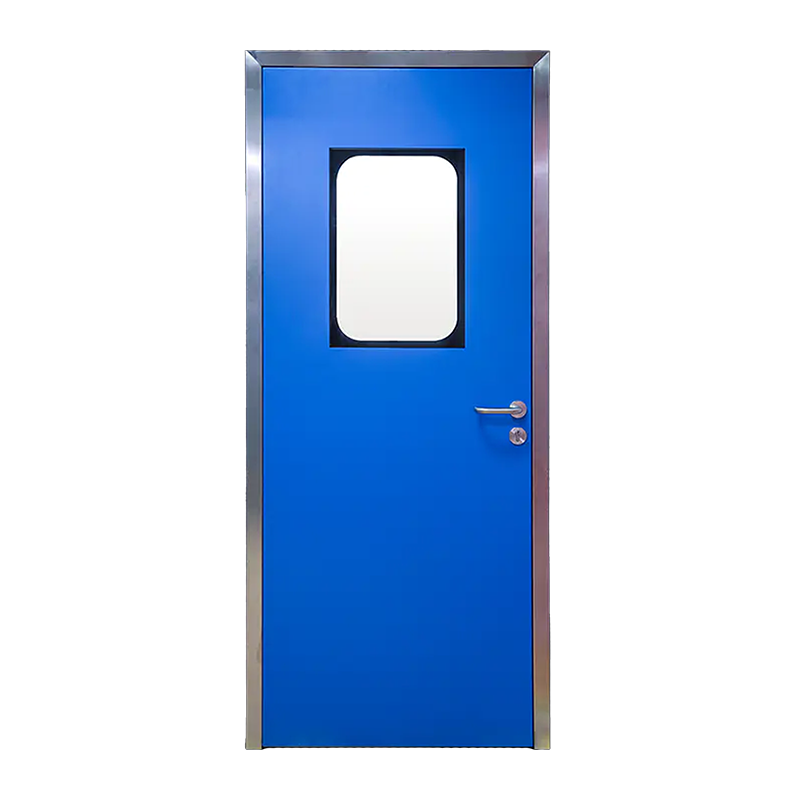
For aggressive chemical washdowns, a stainless steel cleanroom door with 316L construction and a 2B or electropolished finish eliminates the risk of coating delamination. In less demanding environments, an aluminium alloy frame with a melamine resin panel delivers a non-porous, easy-to-clean surface at reduced weight, simplifying hardware adjustments and reducing frame stress over time.
Airtight Sealing: The Core Function of a Cleanroom Door
Cleanroom pressure differentials—typically 10–15 Pa between adjacent zones—require doors to limit air leakage to less than 0.5 m³/h per linear metre at 50 Pa. Achieving this demands a system-level approach: high-rebound EPDM or silicone gaskets on the head, jambs, and an activated bottom drop seal. Multi-point compression locks pull the leaf evenly into the frame so the gasket engages uniformly along the entire perimeter.
Models classified as airtight doors often incorporate inflatable seals that expand after closing to guarantee zero gap, a design critical for high-containment labs (BSL-3, BSL-4) and potent compound handling suites. Commissioning validation with a calibrated anemometer and smoke pencil test confirms that the installed door maintains its rated leakage under worst-case back-pressure conditions.
Fire-Rated Doors in Cleanroom Applications
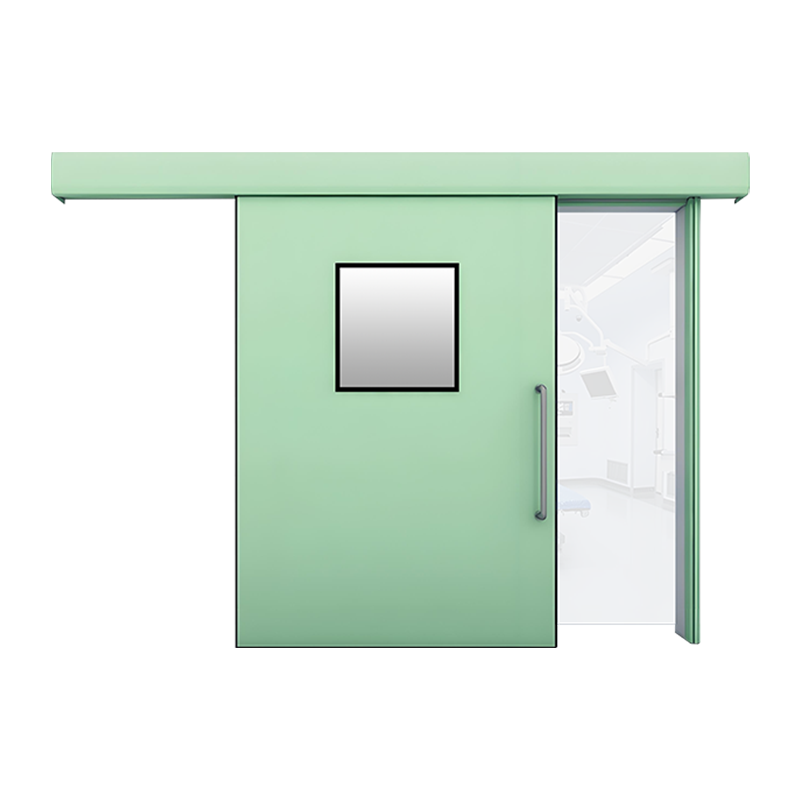
Balancing fire safety with contamination control presents a unique challenge. Standard fire doors use intumescent strips that expand under heat but can shed particles under normal operation, making them unsuitable for cleanrooms. A purpose-built cleanroom fire door integrates a flush intumescent seal embedded within the frame and a factory-applied, seamless coating that withstands both routine VHP (vaporized hydrogen peroxide) cycles and the thermal shock of a fire event.
Fire-rated heat-resistant cleanroom doors can achieve integrity ratings of 60 to 120 minutes while maintaining a completely smooth leaf surface. Specifiers should verify that the door-leaf core and frame assembly have been tested as a complete system, not as individual components, to ensure the gasket sealing performance does not degrade once the intumescent material activates.

Matching Doors to ISO Cleanroom Classes and Regulations
Selecting the right door is not about picking the highest specification across the board; it is about matching door performance to the room’s contamination risk. The following table outlines recommended minimum configurations.
| ISO Class | Surface Finish | Gasket Type | Window Option | Typical Regulatory Context |
|---|---|---|---|---|
| ISO 5 (Grade A) | Stainless steel, electropolished | Fully continuous EPDM, inflatable optional | Flush double-glazed, anti-fog | EU GMP Annex 1, FDA aseptic |
| ISO 6 (Grade B) | Stainless steel or melamine resin | Continuous compression, drop seal | Flush single or double glazed | EU GMP, PIC/S |
| ISO 7 (Grade C) | Painted steel or aluminium-melamine | Continuous compression, drop seal | Optional | ISO 14644, WHO |
| ISO 8 (Grade D) | Painted steel or colour steel panel | Perimeter gasket, bottom brush seal | Optional | ISO 14644, general pharma |
Design teams should cross-reference the room’s defined occupancy state particle counts with the door manufacturer’s third-party test data on surface particle emission and outgassing. For EU GMP Annex 1, the qualification dossier must include documented proof that the door assembly maintains integrity during room sanitization cycles and pressure hold tests.
Installation, Commissioning, and Long-Term Maintenance
A precisely manufactured door can fail if the frame is not installed completely flush with the wall panel. Use a continuous bead of low-VOC, mold-resistant sealant between the frame and the cleanroom partition, tooled smooth to prevent microbial growth. Alignment must be verified with a laser level; a deviation of more than 2 mm over the frame height compromises gasket compression and leads to air bypass.
Maintenance schedules should include monthly visual checks of gasket integrity, annual rebound resilience testing, and replacement of bottom drop seals every two years in high-traffic areas. Train operators to close doors without slamming—impact can deform leaf edges and misalign multi-point locking pins, reducing the door’s airtight performance over time.
Previous Post
Single Glass Cleanroom Windows: Key Specs, Frames & Selection Guide
Next Post
HPL Cleanroom Door Performance in Pharmaceutical and Electronic Industries

Jiangyin Yatai Purification Equipment Technology Co., Ltd. is a modern and specialized manufacturer of clean doors and windows. Cleanroom Project Factory, offer Custom Clean Doors and Windows.
QUICK LINKS
PRODUCTS
GET IN TOUCHs
-
 +86 13616113658
-
 +86(0)510-86661588 / 86668687
-
 [email protected]
-
 +86(0)510-86661588
-
 No.2, Huagang West Road, Shizhuang, Jiangyin, Jiangsu province
© Jiangyin Yatai Purification Equipment Technology Co., Ltd.
All Rights Reserved.
 Cleanroom Door Manufacturers