-
 +86 13616113658
-
 [email protected]
 English
 Español
 русский
 عربى

Home / Media / Industry News / Cleanroom Installation Guide: Build Sequence, Sealing and Envelope Checks
Cleanroom Installation Guide: Build Sequence, Sealing and Envelope Checks
Content
A pharma fill suite in Jiangsu missed its handover date by nine days, and the air handling unit was not the reason. Four door frames had been set on timber packers, the gaskets never compressed evenly, and the room could not hold its differential pressure each time the interlocked doors cycled. On a cleanroom installation, the envelope is where schedules and validation budgets are usually lost, because every sealing detail has to be right before the first particle count means anything.
15 to 25 PaDifferential pressure typically held between adjacent clean zones
0.3 micrometreParticle size used for HEPA and ULPA filter leak scans
4 to 8 weeksTypical modular envelope assembly window after design freeze
What a Cleanroom Installation Actually Includes
Cleanroom installation is the assembly and sealing of the room envelope together with the services and testing that hold pressure, airflow and particle counts inside the design limits. It is not a single trade. Envelope crews, mechanical contractors and validation engineers work on the same square metres, and the interfaces between them are where defects hide.
The work falls into three packages that pass or fail together. Envelope work delivers the physical barrier. Services work delivers the air and utilities that keep the barrier under positive control. Verification proves that both are behaving as designed, under static and operating conditions.
Envelope definition Every surface and joint separating the classified zone from surrounding space: wall panels, ceiling grid, doors, windows, service penetrations, coving and floor upstands. If air can pass through it, it belongs on this list.
Envelope targets are not generic. A class 10,000 room and an ISO 5 room share the same sealing logic but very different tolerances, and the pressure regime follows from the classification, as outlined in this breakdown of ISO 7 limits on airflow and envelope design.
| Package | What gets installed | Sign-off point |
| Envelope | Wall and ceiling panels, doors, windows, coving, floor upstands | Joint and gasket inspection |
| Services | Fan filter units, ductwork, diffusers, electrical, process gas | Balancing report |
| Verification | Particle counts, pressure decay, filter scan, recovery test | Validation certificate |
The Build Sequence That Prevents Rework
The sequence that avoids rework is design freeze, offsite manufacture, staged delivery, envelope erection, door and window setting, services connection, then balancing and validation. Any project that installs doors before the ceiling grid is fixed will re-set those doors later.
Freeze the interface drawings
Opening sizes, panel module, ceiling grid and service penetrations are agreed before fabrication starts. A 20 mm shift at this stage is free; the same shift after panel cutting is a purchase order.
Manufacture offsite
Panels are cut and edged, door leaves assembled and glazed, frames welded and coated. Factory cutting removes the largest single source of on-site dust.
Stage the delivery
Materials arrive in erection order, stored flat with edges protected. Panels stacked on their corners deform and never sit flush again.
Erect the envelope
Floor track, wall panels, ceiling grid and coving. Cut edges get sealed as the crew moves, not at the end of the shift.
Set doors and windows
Anchors, shims, gaskets, closers and interlocks. Frames are checked for plumb and for even gasket contact around all four sides.
Connect services and balance
Ductwork, fan filter units and controls are commissioned, then airflow and pressure are balanced zone by zone.
Validate
Filter scan, particle counts at rest and in operation, recovery test and documentation handover.
Modular or Stick-Built: What Changes on Site
Modular installation moves cutting, welding and painting offsite, so site work becomes assembly and sealing rather than wet trades. That single change drives most of the schedule difference between the two approaches.
Modular envelope
- Factory-cut panels with sealed edges
- Dry assembly, minimal on-site debris
- Tolerances set by the production line
- Panels removable for later alterations
Stick-built envelope
- Stud, board and coating built in place
- Cutting and sanding inside the future clean zone
- Tolerances depend on site labour
- Alterations mean cutting and patching
| Attribute | Modular envelope | Stick-built envelope |
| Site duration | Assembly only, often 4 to 8 weeks | Wet trades and curing extend the programme |
| Dust load during build | Low, components arrive finished | Higher, cutting and sanding on site |
| Tolerance control | Set at the factory, repeated panel to panel | Depends on crew skill and supervision |
| Later alteration | Panels unbolt and reposition | Cutting, patching and recoating |
| Expansion | Bolted onto the existing frame | New structure usually required |
If the room must be validated inside a single shutdown window, modular usually wins on schedule. If the footprint is fixed for fifteen years and services are dense, a stick-built shell can still be competitive on total cost.
Doors, Windows and Panels Decide the Seal
Doors, windows and panel joints decide the seal because they are the only places where the envelope is interrupted by movement. A panel field is static; a door is opened hundreds of times a day, and every cycle tests the gasket, the frame fixing and the threshold detail.
Door frames, gaskets and thresholds
Flush-mounted frames sit level with the wall face and clean down without a ledge, which is why they dominate pharmaceutical and electronics work. Surface-mounted frames are easier to retrofit but collect dust on the reveal. Gasket compression should land near one third of free height: too little and the door whistles, too much and the leaf needs a shoulder to close, which users defeat by propping it open.
For high-traffic corridors, sliding leaves remove the swing arc and the associated pressure pulse. The cleanroom door range covers hinged, sliding and interlocked configurations so that frame, gasket and hardware come from one sealing system rather than three suppliers.
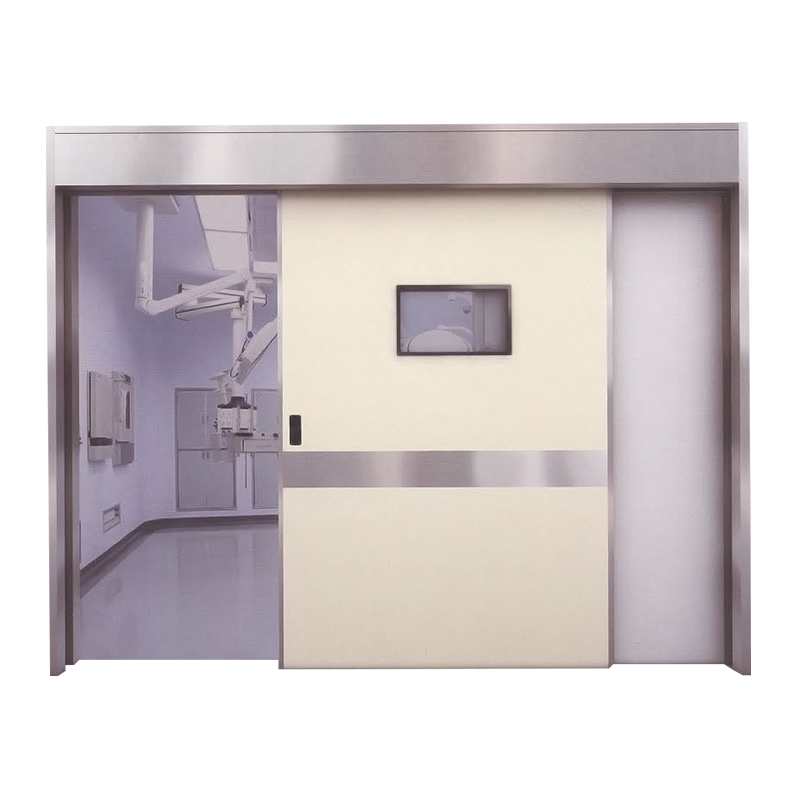 Airtight Automatic Sliding Cleanroom DoorAutomatic sliding cleanroom door with flush installation, magnetic drive and level 8 airtightness for high-traffic corridors needing sealing and smooth passage.View Product →
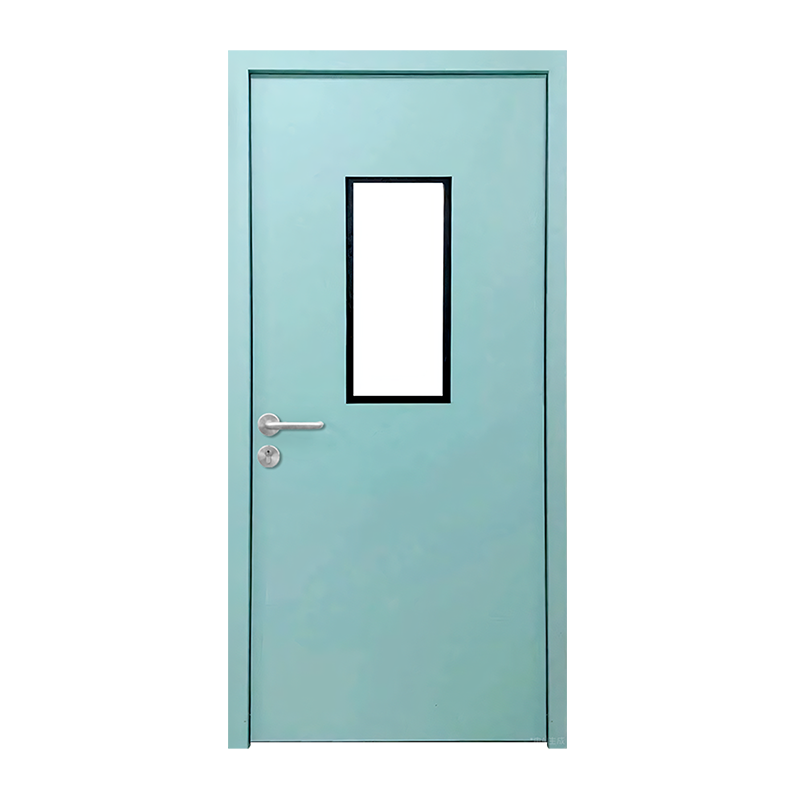
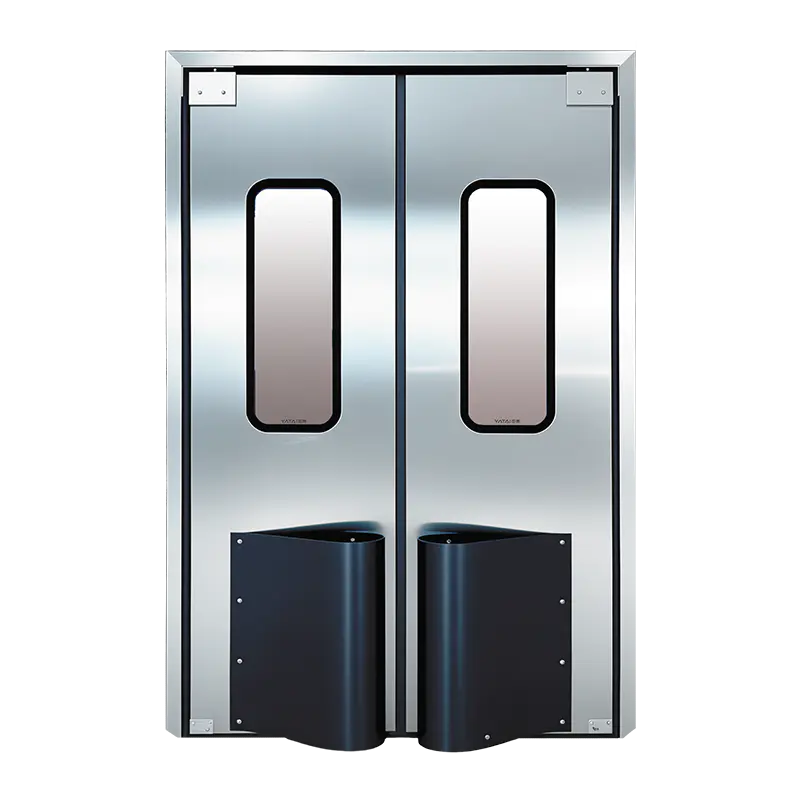
 Flat Frame Steel Cleanroom DoorSeamless flat-frame steel cleanroom door with double-glazed flush window and automatic bottom sweep, suited to cleanroom walls and easy-clean environments.View Product →
Window and glazing details
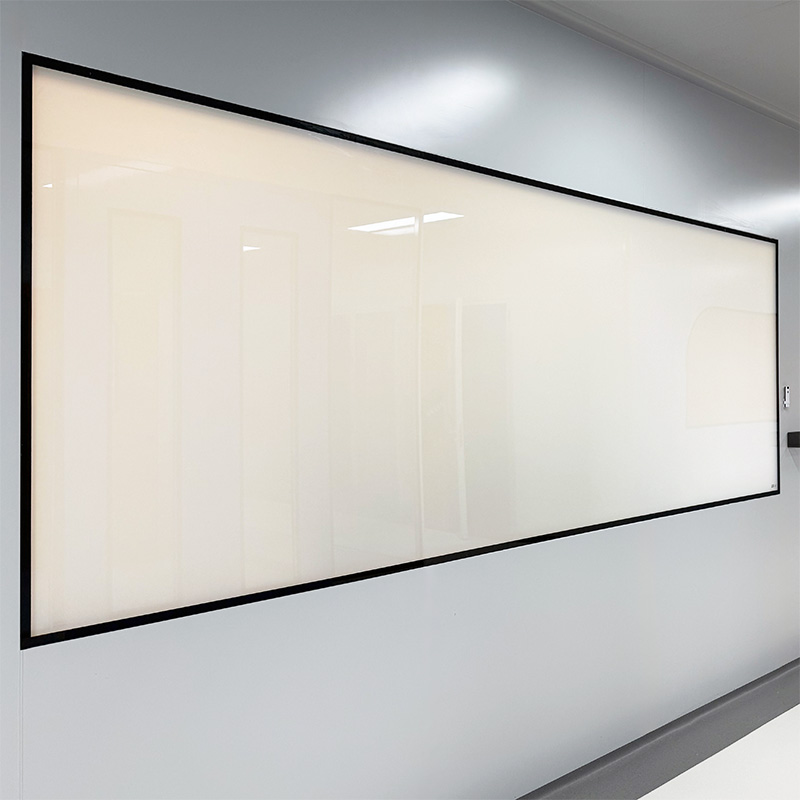
Windows leak at the perimeter, not through the glass. Flush glazing on both faces with radius corners and a continuous silicone bead gives a cleanable junction; a sharp internal corner will hold residue no matter how often it is wiped. Double glazing helps where the room sits beside a noisy plant area, and dimmable glazing removes the need for blinds that shed particles.
Panel cores and fire performance
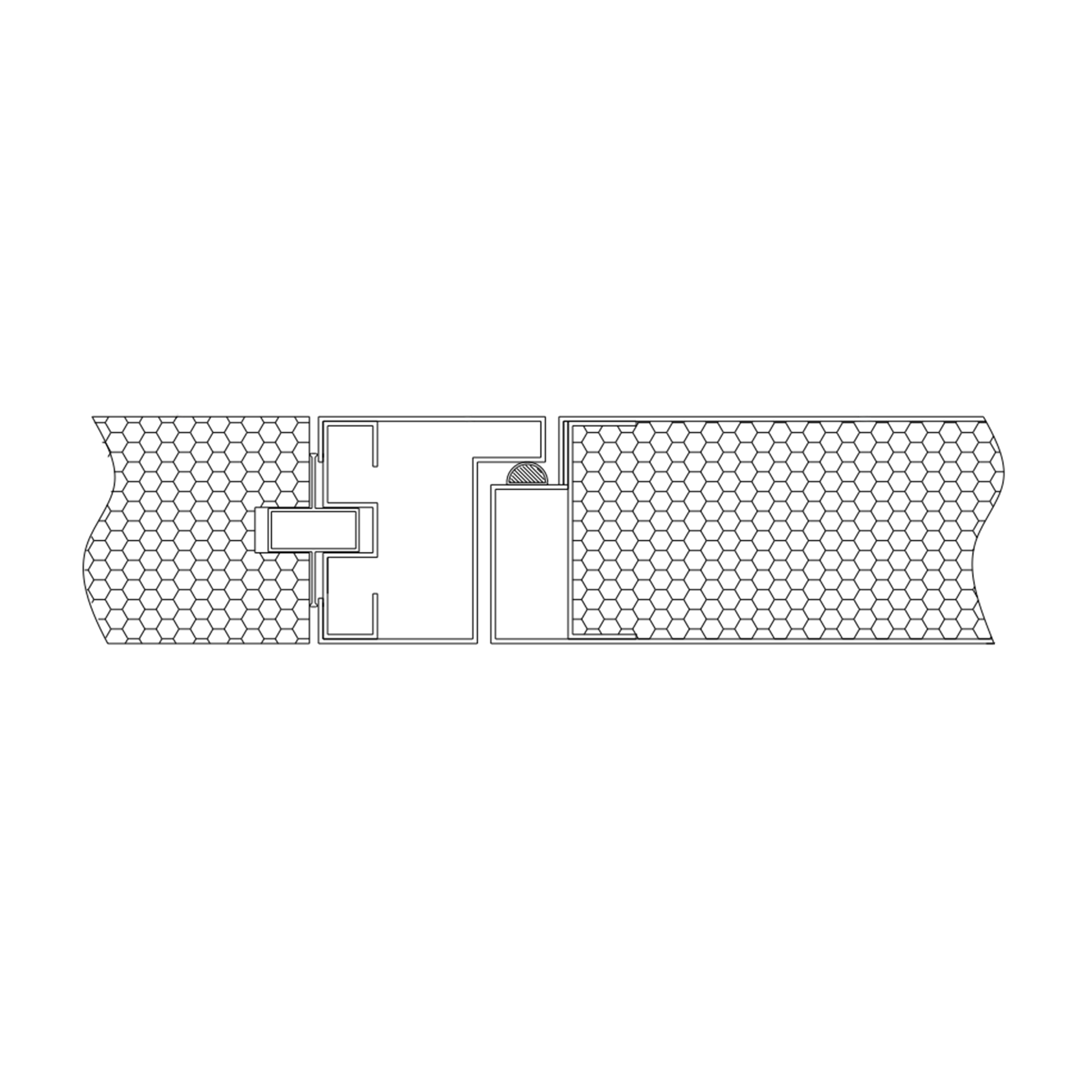
Core choice follows the risk profile, not the price list. Rock wool suits fire-rated partitions and compartment walls, polyurethane gives strong thermal performance for cold or controlled-temperature rooms, and aluminium or paper honeycomb keeps large lightweight panels flat. Cut edges must be protected during erection, because a moisture-wicking core will swell and distort the panel face within a season.
 Handmade Rock Wool Sandwich PanelHandmade rock wool sandwich panel suited to fire-rated partitions and compartment walls; use the quote and download links to confirm specifications.View Product →
Specify doors, windows and panels as one sealing system. When the frame profile, gasket groove and panel edge come from different sources, the installer improvises at the junction, and improvised junctions are the ones that fail validation.
Testing and Validation Before Handover
Validation proves the installed envelope holds its design pressure and particle class under real operating conditions, not only at rest. The test list below is the minimum most pharmaceutical and electronics clients will accept.
Book the validation team before the envelope is closed. A frame that moves after the filter scan invalidates both the scan and the particle count, and the repeat usually lands on the critical path.
| Test | Method | Typical acceptance |
| Pressure differential | Gauge reading across adjacent zones | 15 to 25 Pa held with doors closed |
| Filter integrity | Aerosol scan at the filter face | No leak above 0.01 percent of challenge |
| Airflow volume | Hood reading at each terminal filter | Within 15 percent of design value |
| Particle count | Counter sampling at rest and in operation | Meets the ISO 14644-1 class limit |
| Recovery time | Challenge, then timed counting | Return to class inside the design window |
| Door seal check | Smoke pencil at gaskets and sills | No visible leakage path |
Pressure decay is the fastest diagnostic you have. Close every door, isolate the zone and watch the gauge. A drop that continues past the design allowance points to the envelope, not the air handling unit, and the search should start at door sills and cable penetrations.
Where Installations Fail and What It Costs
Most cleanroom envelope failures come from five repeatable details rather than from major equipment. All five are cheap to prevent before the panels go up and expensive to correct afterwards.
Unsealed penetrations
Cable, duct and pipe entries sealed with the wrong mastic, or not sealed at all. Every one of them is a controlled leak into a classified zone.
Packed door frames
Timber or plastic packers compress over months. The frame moves, the gasket loses contact at the head, and the door starts to whistle.
Over-compressed gaskets
A leaf that needs force to close gets propped open by staff, and the pressure regime collapses quietly without any alarm.
Panel joints on the airflow path
Seams aligned with supply air scour dust out of the joint every time the fan filter units ramp. Stagger joints away from diffusers.
Unprotected cut edges
Exposed cores absorb moisture during construction, swell, and deform the panel face. Seal edges as they are cut, not at the end of the job.
A single leaking door frame can cost more in re-validation than the door itself, because the filter scan, particle count and pressure test all have to be repeated on a room that was already signed off once.
Frequently Asked Questions
How long does a cleanroom installation take?
A modular envelope for a mid-size room usually assembles in four to eight weeks after design freeze, with services and balancing running in parallel. Validation adds one to two weeks depending on the number of zones and the sampling plan.
Should doors be installed before or after the ceiling grid?
After. The ceiling grid fixes the head detail and the provisional pressure that keeps dust out of the room while frames are being set. Doors installed first almost always need re-setting once the grid is loaded.
What causes the most validation failures?
Gasket contact at door frames and unsealed service penetrations account for most repeat tests. Both are visible with a smoke pencil during a walk-through, which is why the pre-validation inspection is worth scheduling properly.
Can cleanroom windows sit flush with the wall?
Yes. Flush glazing on both faces with radius corners and a continuous silicone bead is standard for pharmaceutical and electronics rooms, and it removes the horizontal ledge that collects residue.
Envelope quality is decided in the detail drawings, not on the day of the particle count. Fix the frame, gasket and panel interfaces first, and the rest of the cleanroom installation becomes a schedule exercise rather than a repair project.
Previous Post
No previous article
Next Post
Antimicrobial Surfaces in Cleanrooms: Materials, Testing and Selection

Jiangyin Yatai Purification Equipment Technology Co., Ltd. is a modern and specialized manufacturer of clean doors and windows. Cleanroom Project Factory, offer Custom Clean Doors and Windows.
QUICK LINKS
PRODUCTS
GET IN TOUCHs
-
 +86 13616113658
-
 +86(0)510-86661588 / 86668687
-
 [email protected]
-
 +86(0)510-86661588
-
 No.2, Huagang West Road, Shizhuang, Jiangyin, Jiangsu province
© Jiangyin Yatai Purification Equipment Technology Co., Ltd.
All Rights Reserved.
 Cleanroom Door Manufacturers